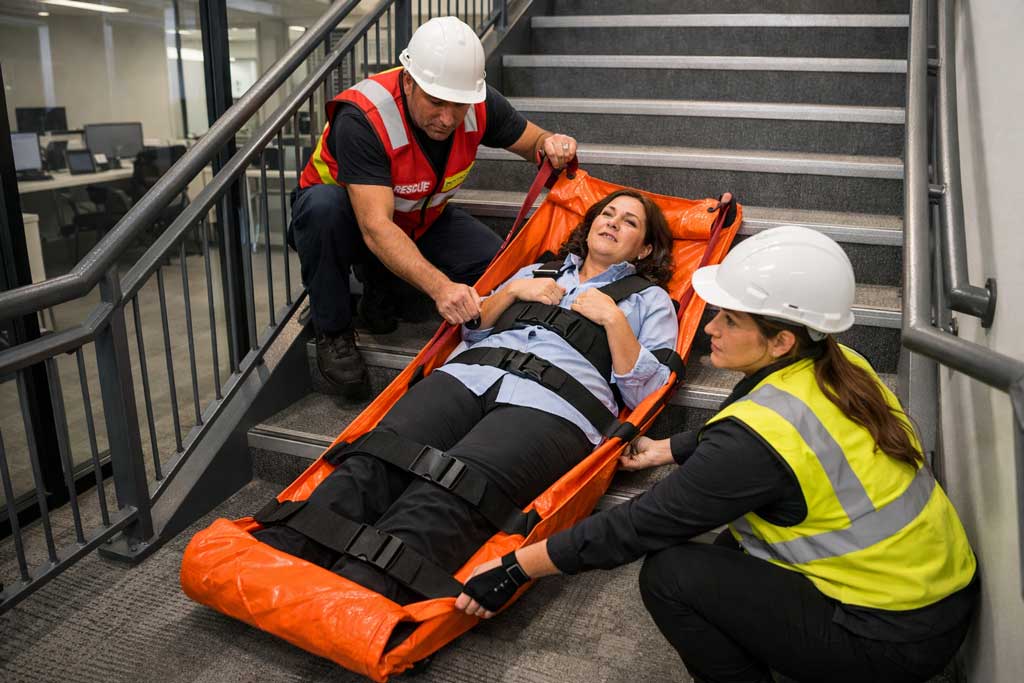
In an emergency, every second counts – especially in busy commercial premises and multi-occupancy buildings. While some people can make their own way to the nearest exit, others may rely on staff or colleagues to help them move quickly and safely. This is where an evacuation mat comes into its own, giving duty holders a practical way to evacuate anyone who cannot easily use the stairs or walk unaided.
What Is An Evacuation Mat?
An evacuation mat is a low-profile rescue device used to move people who cannot walk, stand or transfer safely during an emergency evacuation. Sometimes called evacuation sledges or pads, these products typically feature a padded base, integrated safety straps and strong handles so that trained staff can slide a person across floors and down stairways to a place of safety.
Unlike evacuation chairs, which require the evacuee to sit upright, an evacuation mat allows the person to remain in a lying position, making it suitable for those with spinal injuries, reduced mobility or who are unconscious. The smooth underside lets the mat glide over surfaces such as carpet, vinyl and concrete, while the raised sides and straps help keep the occupant secure in transit.
Why High-Rise Buildings Need Evacuation Mats
High-rise buildings introduce additional risks and complexities during an evacuation, particularly where lifts cannot be used because of fire. In these situations, stairwells become the main escape routes and anyone who cannot manage stairs independently will need assisted evacuation.
An evacuation mat supports this by:
- Allowing rapid movement down staircases where evacuation chairs might not be suitable or available.
- Reducing manual handling risks for staff by spreading the person’s weight across a sliding surface rather than lifting or carrying.
- Providing a cost-effective option when you need to plan for multiple mobility-impaired occupants, for example in care homes, hospitals, hotels or large office towers.
Because they store compactly in wall-mounted bags or cupboards, multiple mats can be positioned on different floors close to stair cores, helping responsible persons meet their duties under fire safety and health and safety legislation.
Who Might Need To Use An Evacuation Mat?
Any organisation that has staff, visitors or residents who may struggle to self-evacuate should consider incorporating an evacuation mat into their emergency planning. This includes:
- Employees with long-term mobility impairments or wheelchair users.
- Pregnant workers or those recovering from surgery or injury.
- Visitors, contractors or members of the public with temporary conditions, such as broken bones or reduced mobility.
- Patients or residents in healthcare, residential and education settings.
By including evacuation mats within Personal Emergency Evacuation Plans (PEEPs), employers can demonstrate that they have made reasonable adjustments for at-risk individuals and reduced reliance on ad-hoc lifting or carrying during a crisis.
Are Evacuation Mats Only For High-Rise Buildings?
While evacuation mats are often associated with tall buildings and complex stair cores, they can also be valuable in some ground floor environments. For example, large single-storey offices, warehouses, schools or healthcare facilities may still need to move people over longer distances or through congested areas where wheelchairs or beds are difficult to manoeuvre.
In a ground floor office, an evacuation mat may be used to:
- Move someone away from an immediate hazard, such as smoke, fire or structural damage, to a safe exit.
- Navigate tight corridors, crowded open-plan areas or uneven thresholds where wheeled equipment becomes harder to control.
- Assist individuals who have collapsed or become unconscious during an incident and cannot be safely lifted.
That said, some small, straightforward ground floor premises with wide exits and low occupant risk may rely on other forms of assistance, provided a suitable risk assessment and robust evacuation procedures are in place.
Building Evacuation Mats Into Your Emergency Plan
Selecting the right evacuation mat starts with a thorough fire risk assessment and review of your building layout, occupant profile and existing equipment. Key considerations include weight capacity, ease of use on your specific floor finishes and stair types, storage options and how quickly the mat can be deployed in a real emergency.
Once chosen, it is important to:
- Assign responsibility for using the evacuation mat within your emergency plan.
- Provide hands-on training for fire wardens and relevant staff, including practice drills.
- Keep the equipment accessible, clearly signed and regularly inspected so it is always ready for use.
By integrating evacuation mats into your overall strategy – alongside alarms, signage, compartmentation and staff training – you give your organisation a practical, compliant way to safeguard anyone who cannot manage the stairs, whether you operate from a high-rise tower or a busy ground floor office.
Featured image credit: AI generated.